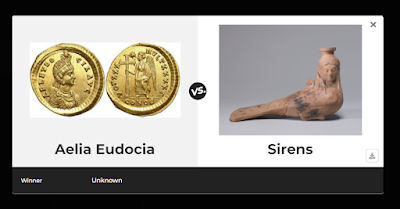
As February comes to a close and the Kalends of March approach, a time-honored tradition looms on the horizon: Martia Dementia! Every March, Bolchazy-Carducci sets a number of matches between ancient figures and allows them to play out until one victor (or victrix) emerges. This year, monuments of the Mediterranean (and beyond) will return from the 2024 bracket to compete against “people” of the announced AP® Latin syllabus. These "people" include figures from the Vergil and Pliny texts as well as figures from and the authors of the suggested companion "teacher choice" selections. Whether ancient authors, epic heroes, poetic personae, epistolary addressees, or in one case, a volcano, these literary personalities will prove worthy foes for the likes of the Colosseum and the Hanging Gardens of Babylon.


To the victor—whoever finishes with the best bracket—belong the spoils. Before getting to the prizes, here is how the competition will work. Please read through the process carefully.
The Bracket
Starting today, complete and submit a bracket to be eligible for wondrous prizes. Please access and submit your bracket online via the following link: Martia Dementia 2025 Bracket. (Update: due to popular demand, we have also provided a printable bracket for reference.)
When you access the online Martia Dementia bracket, click the “Submit your bracket!” button to start making your selections. You will be prompted to enter your name and email address; we need this information so that we can track and notify the winners of the competition once Martia Dementia is completed. After signing up, you will be asked to predict a winner for each game in the bracket.
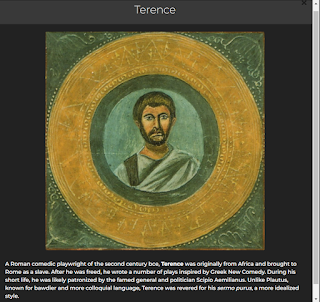
At the bottom of this post, you will find a link to a PDF showing short descriptions of each of this year’s Martia Dementia participants. You can access the same descriptions by clicking on the photo of a given figure in the bracket.
Once you have completed all of your selections and have submitted your bracket, you will receive a notice thanking you for your submission.
If you would like to view your prediction bracket, simply click on the link to “View My Prediction.” We recommend saving a copy of your bracket at this point so that you can keep track of how you are doing as the competition progresses. With our online submission system, you can also easily share your prediction bracket via email or social media—a great way to show off how you’re doing, or earn some pity points if your bracket is going poorly.
Brackets will be accepted through Wednesday, March 19.
The Survey
A voting survey will be made available on Thursday, March 20, where you can vote for your picks. Whichever figures have the most votes by the time the survey closes will advance through the round. Actively participating in the survey betters your chances at winning. We will announce via social media when voting for each round has opened.
We cannot stress enough the importance of voting. When the survey goes live, cast your votes! Get your friends to vote for your picks. Teachers, get your students to stuff the survey with favorable votes!
Victori Spolia
This competition is not solely for bringing glory to your favorite ancient writer or bird. Bolchazy-Carducci Publishers is offering book prizes for the brackets that most closely resemble the final results; a $100 book credit will be awarded to the first-place participant, a $50 credit to the second-place participant, and a $25 credit to the third-place participant. Feeling like you no longer stand a chance? Do not give up! There will also be a $25 credit for having the most abysmal bracket!
Stay Connected
Be sure to bookmark this post and check back here to access the link to the voting bracket. Also, follow us on Facebook for updates as the competition progresses.
Remember, brackets close March 19, and the first round of voting will begin March 20.
Bracket and Other Resources
Access a printable bracket (for reference only)
Access a description of all Martia Dementia 2025 figures
Voting Schedule:
· Round 1: March 20–21
· Round 2: March 22–25
· Round 3 (Sweet 16): March 27–28
· Quarterfinals (Elite 8): March 29–April 1
· Semifinals (Final 4): April 2–4
· Final (Championship): April 7–9
Note that each round of voting will open at 7:30 a.m. central time and close at 4:00 p.m. central time on the designated days.
Advanced Placement® and AP® are trademarks registered and/or owned by the College Board, which was not involved in the production of, and does not endorse, this product.